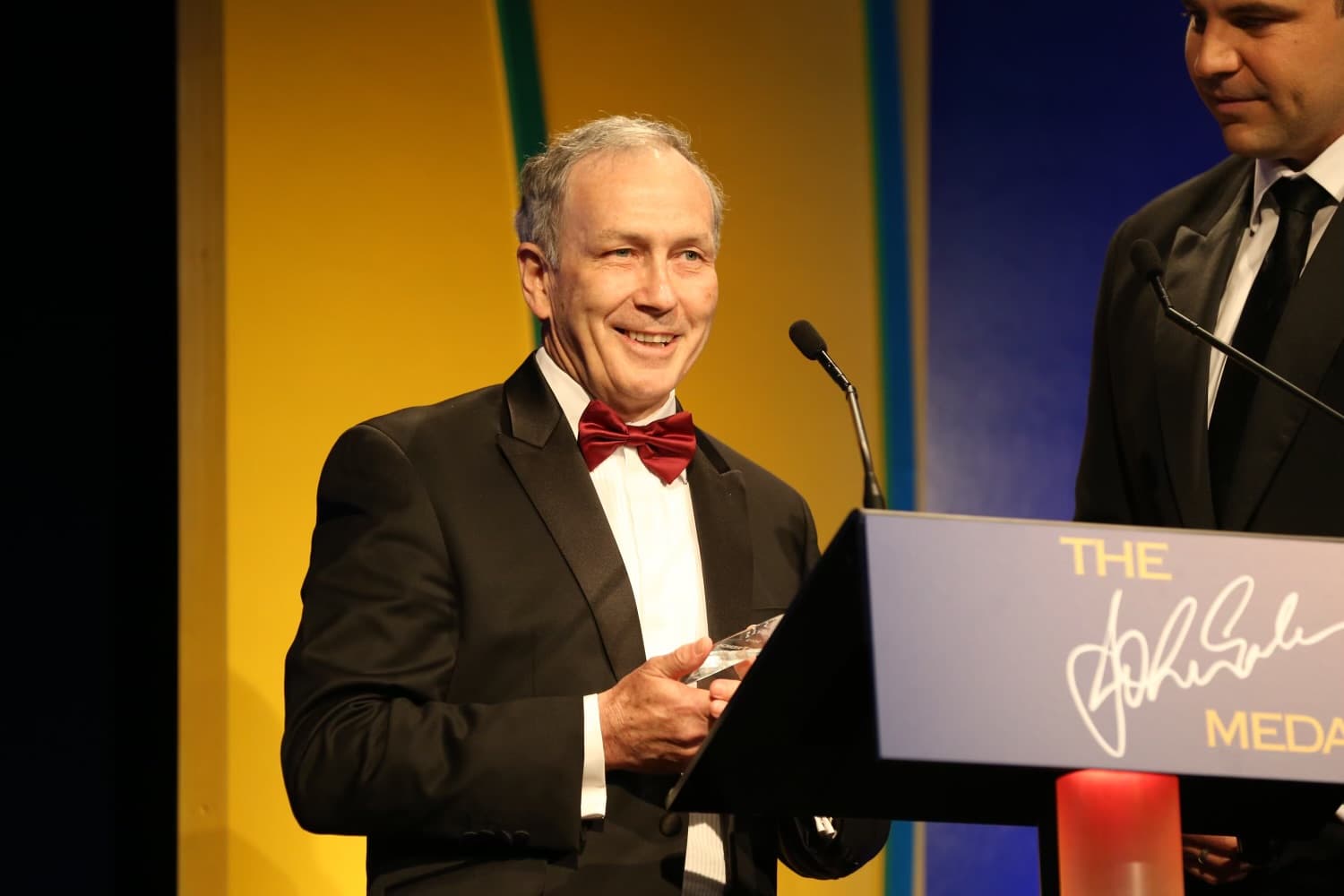
Only one name would bounce back if you quizzed any group of Brisbane footballers over the past 40 years with this simple clue - “the knee guy?”
Doctor Peter Myers has been that influential as the knee surgeon to our sporting elite as one of Queensland’s leading orthopaedic surgeons.
Wally Lewis, Tim Horan, John Eales, Chris Latham, Michael Voss, Darren Lockyer, Jamie Dwyer…
The list across rugby goes on and on just as there are footballers of all codes and Olympic gold medallists in various sports who have saluted his expertise and care.
You can throw in labourers and dancers too. No occupation is spared from the grumbling knee.
At 71, Dr Myers is still offering second opinions, teaching, advising and assisting in surgeries.
There was a poignant moment last week when Eales, Horan and Brett Robinson initiated a dinner in Brisbane to say “thank you.”
There were eight past rugby luminaries there. All had a surgery tale to tell as do more than 60 former Queensland Reds across the years.
“Done the ACL” is one of sport’s most dreaded phrases.
Tearing the Anterior Cruciate Ligament is season-ending. Surgery and diligent rehabilitation is a seven-to-nine month process, often longer.
Remarkably, five Wallabies - Will Genia, Quade Cooper, David Pocock, Stephen Moore and Kane Douglas - ran on for a 2016 Test against the All Blacks thanks to a sturdy knee reconstruction from Dr Myers in their histories.
Dr Myers has operated on tens of thousands of knees and shoulders but one still stands out in rugby for its severity and the return to the top that followed.
“As far as getting back to the top in rugby, Tim Horan, stands out. The surgery is one thing. The average punter might just not have the back up to do what he did to return,” Dr Myers said.
The left knee of Wallaby great Horan looked like it had been hit by a limo when it gave way during the 1994 Super 10 final in Durban.
His ACL was ruptured and so was his medial ligament. His lateral and medial cartilages were both torn and crushed. His patella was dislocated and a piece of bone bigger than a $1 coin had been chipped off.
Walking properly again was the first humble aim because rediscovering his electrifying pace and drive through tackles looked a lost cause. Dr Myers virtually gave Horan a new knee with the screwing, stapling, drilling, cleaning and sewing of a lengthy operation.
Horan would lie face down on the physio bench in the months that followed. He’d use the pillow to muffle his screams as his left leg was manoeuvred.
Horan made it back against the odds for the 1995 World Cup and was Player of the Tournament at the 1999 World Cup won by the Wallabies.
“Pete has ridden the journey of many rugby players over many, many years. It’s been a wonderful career,” Horan said.
“For me, I remember the date, May, 14, 1994. I did my knee, he repaired it and saved my career.”
Eales could not lift a coffee pot above his head to start 1999 until Dr Myers performed a shoulder reconstruction. By the end of that year, he was holding aloft the Webb Ellis Cup.
The stories are everywhere.
Former Queensland winger-fullback Richard Graham broke his thigh bone during a GPS vs Wests club game at Sylvan Road in 1992.
When it was suggested the ambulance take him to Brisbane’s largest hospital, teammate Anthony Herbert blurted: “Bugger that, he’s going to Doc Myers.”
The only problem was Myers was on holidays on the Gold Coast.
“Doc drove up from the Gold Coast and operated on the leg that same day for four hours. He’s a great man,” Graham said.
Former Wallaby Pat Howard had a New Year’s Eve accident in the mid-1990s.
It wasn’t a rugby injury. He’d jumped off a balcony. Myers broke from his own holidays to repair the arm. That’s why Howard wore that Mal Meninga-style armguard when he began his ACT Brumbies career.
Former Reds and Fiji halfback Jacob Rauluni was a regular customer.
“Three knee ops on the left knee, one on the right and no dramas,” Rauluni said.
“My dad (former Queensland halfback Taito Rauluni) and Peter used to play club rugby against each other so we’d chat about the old days.
“He was the go-to surgeon and is a legend of a bloke as well.”
Robinson actually did his medical training under Myers in the mid-’90s.
“As a young graduate I was fortunate to train as a doctor under Peter. He had a huge influence on my life professionally and personally,” said Robinson, how the Chair of World Rugby.
“I had two knee arthroscopes, a shoulder operation and an ankle operation. It’s wonderful to be able to say thank you for his contribution to rugby.”
At 65, Queensland’s former Wallaby lock Nigel “Shredder” Holt can walk on the cobblestoned streets of Europe on holidays and swat golf balls wildly because of Myers.
“Thanks to all the work that Pete has done on me I am enjoying retirement,” Holt said.
“We’ve known each other through knee reconstructions and now two knee replacements.
“I know I’ve probably paid for three extensions on his home but he deserves every bit of it.”
In the 1970s, you could always tell knee injury victims at a party. The old footy player would hitch up a trouser leg or compare scars with a skiier who’d come a cropper.
The long, twin scars, either side of the kneecap, from the operation were purple-red and raw for months. They were markings for life.
Myers was at the cutting edge when knee surgeries changed forever. He was the first overseas-trained Queensland orthopedic surgeon to perform knee reconstructions inside the knee joint in the late 1980s and was in the vanguard when arthroscopic or keyhole surgery became the mode in the early 1990s.
Myers never “did a knee” himself as a player. He was a sniping first grade halfback for University of Queensland in the mid-1970s when Wallabies Mark Loane, Paddy Batch, Bill Ross, Geoff Shaw, Andy McIntyre and Duncan Hall were regular teammates.
With the UQ clubhouse to be torn down after Saturday’s final round of club rugby, Myers’ mind wandered back to the “older” clubhouse when Harpoon Harrys bar held many secrets.
Myers sat on the bench for Queensland a single time in 1977 without getting on the field.
Myers does have a final note of advice. More research into muscle strength, workloads and knees is needed in women’s sport because the number of ACL injuries has exploded with the rise of the women’s footy codes.